JR Geo Guide: Meaning, Uses & Practical Insights
If you’ve searched for JR Geo, you’re likely trying to understand what it actually means and how it applies to real-world mapping, surveying, or geographic analysis. The problem is that most online content gives either a shallow explanation or mixes unrelated definitions without clarity.
Geospatial technology is expanding fast. From land surveying to smart city planning, geographic data now influences decisions that affect infrastructure, agriculture, disaster response, and even marketing strategies. In that context, JR Geo is commonly associated with geographic information systems (GIS), land mapping services, or spatial data analysis solutions.
As someone who has worked closely with GIS workflows and mapping tools, I’ve seen how misunderstood geo-based systems can be. This article explains JR Geo clearly, practically, and in a way that actually helps you apply it.
What Is JR Geo?
JR Geo typically refers to a geospatial mapping or geographic data solution. Depending on context, it may represent a surveying service, GIS-based platform, or regional geographic consultancy. At its core, JR Geo operates within the ecosystem of Geographic Information Systems (GIS). GIS is a framework that collects, manages, analyzes, and visualizes spatial or geographic data.
A widely recognized GIS platform is ArcGIS, developed by Esri. Such platforms allow professionals to layer maps with roads, elevation, boundaries, utilities, and demographic data. JR Geo services or systems often rely on similar geospatial technologies. In simple terms, JR Geo is about turning geographic data into usable insights.
Why JR Geo Matters Today
Geographic data is no longer limited to scientists or government agencies. Today, construction companies, farmers, logistics providers, and urban planners depend on spatial analysis.
For example, agencies like the U.S. Geological Survey provide geographic datasets that support land management, mineral tracking, and environmental monitoring. Without accurate geo-data systems, infrastructure projects and environmental policies would be far less reliable. The rise of remote sensing and satellite imagery supported by research from NASA has further expanded the importance of geospatial systems. JR Geo fits into this broader transformation where location intelligence drives smarter decisions.
Core Components Behind JR Geo Systems
Understanding JR Geo becomes easier when we break it down into functional layers.
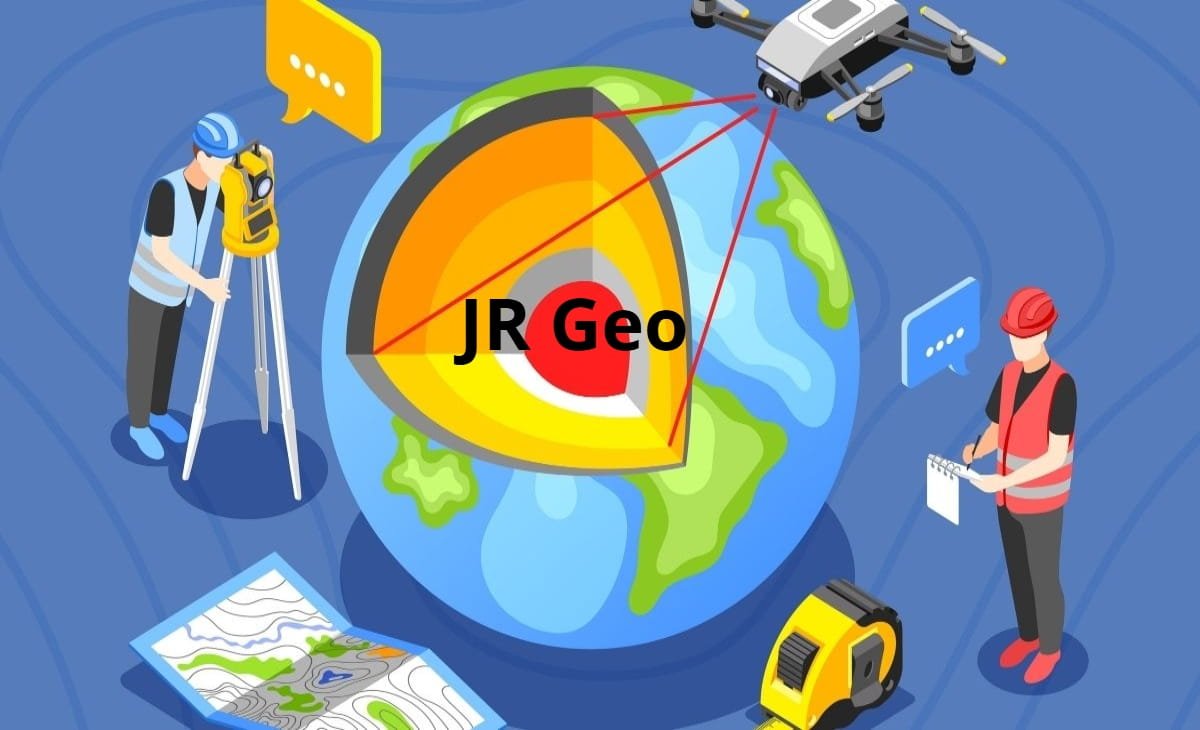
The first component is spatial data collection. This may involve GPS measurements, drone surveys, satellite imagery, or ground-based mapping. High-resolution data ensures accurate modeling.
The second component is GIS processing. Tools such as QGIS help organize and analyze mapping layers. Roads, land boundaries, water bodies, elevation, and zoning data are layered together to create comprehensive maps.
The third component is analysis and interpretation. Raw maps alone do not create value. The real benefit comes from identifying patterns such as flood-prone areas, construction feasibility, or demographic clusters.
The final component is reporting. JR Geo solutions often provide structured maps, digital models, and technical documentation that guide decision-making.
Real-World Applications of JR Geo
JR Geo systems are practical and widely applicable. In urban development, accurate land mapping prevents boundary disputes and costly construction errors. I have seen projects delayed because initial site surveys lacked precise coordinate validation. A structured geo-based approach solves that issue early.
Agriculture, geospatial mapping improves irrigation planning and crop management. Farmers can identify soil variability and optimize fertilizer use. In disaster management, spatial modeling helps identify high-risk flood zones or earthquake-prone areas before damage occurs.
In infrastructure planning, elevation and terrain analysis support road and bridge design, minimizing long-term maintenance costs. These examples show that JR Geo is not theoretical, it is operational and impactful.
Benefits of Using JR Geo
One of the biggest benefits is improved accuracy. Geographic errors can lead to financial losses, legal disputes, and safety hazards. Another major benefit is efficiency. When spatial data is visualized clearly, complex decisions become simpler. Instead of reading spreadsheets, planners can see patterns directly on maps.
Risk reduction is also significant. Flood zones, unstable terrain, or regulatory boundary issues can be identified before major investments are made. Strategic planning becomes stronger when location-based data informs decisions. Businesses choosing store locations, for example, can analyze traffic flow and population density before committing resources.
Common Misconceptions About JR Geo
A common myth is that geospatial systems are only for large governments. In reality, small businesses and independent consultants increasingly use GIS tools.
Another misconception is that geo-mapping is too technical. Modern platforms are intuitive and accessible, even for beginners. Some believe satellite images are always accurate. In practice, data resolution, update cycles, and coordinate systems must be carefully verified. Professional validation remains essential.
How to Implement JR Geo in Your Workflow
If you want to use JR Geo effectively, start by defining your objective. Are you mapping property lines, analyzing land suitability, or planning infrastructure?
Next, gather reliable data. Use verified GPS sources, updated satellite imagery, and local survey documentation.
Then, process the information using GIS software. Even open-source platforms can deliver strong analytical capabilities.
After analysis, validate the results. Cross-check projections, coordinate systems, and scaling.
Finally, convert the output into clear visual reports and insights. Maps must answer specific questions, not just display information.
From professional experience, beginning with a small pilot area reduces risk and improves understanding before scaling up.
Challenges and Risks
Despite its advantages, JR Geo systems are not without challenges.
Data inconsistency can lead to incorrect analysis if sources are outdated.
Advanced GIS licensing costs may be high for enterprise-level projects.
Projection errors can distort spatial relationships if not configured correctly.
Privacy concerns may arise when mapping population data or private land records.
Proper training and compliance with local regulations are critical.
Visual Suggestions for Better Engagement
To make JR Geo easier to understand, include visual elements such as layered GIS map screenshots, drone survey comparisons, or workflow diagrams showing data collection to final reporting.
A simple visual explaining coordinate systems versus projection systems can also help readers grasp technical differences. Charts comparing traditional surveying methods with modern GIS mapping could strengthen credibility.
Frequently Asked Questions
What does JR Geo stand for?
JR Geo typically refers to a geospatial mapping or geographic data analysis service used for surveying, planning, and spatial intelligence.
Is JR Geo a company or a tool?
The term may represent either a geographic service provider or a GIS-based solution, depending on context.
How accurate are JR Geo systems?
Accuracy depends on data sources, satellite resolution, and processing methods. Professional systems can achieve high precision when properly calibrated.
Can small businesses use JR Geo solutions?
Yes. Many small businesses use GIS tools for site planning, logistics, and location analysis.
What software is commonly used in geo-based systems?
Popular tools include ArcGIS, QGIS, and satellite visualization platforms.
Conclusion
Geospatial intelligence is no longer optional for land development, infrastructure, agriculture, or environmental management. JR Geo represents a structured approach to understanding and applying geographic data effectively. When used correctly, it reduces risk, improves planning accuracy, and supports smarter decision-making. Whether you are a developer, surveyor, researcher, or business owner, integrating geo-based analysis can give you a strategic advantage.
If you are serious about leveraging location intelligence, start with reliable GIS tools, validate your data carefully, and continue learning advanced spatial techniques. Explore further resources, consult experienced geo-specialists, or begin experimenting with open-source GIS software to build hands-on expertise. The future of planning is spatial and those who understand geospatial systems today will lead tomorrow’s infrastructure decisions.