İNS Explained: How Inertial Navigation Systems Work Today
Navigation used to depend on stars, maps, and external signals. Today, some of the most critical navigation decisions are made without relying on anything outside the vehicle itself. This is where İNS, or Inertial Navigation System, becomes essential. From commercial aircraft and submarines to missiles, drones, and self-driving vehicles, it’s quietly powers movement when GPS is unreliable, denied, or deliberately jammed.
As someone who has worked closely with aviation engineers and autonomous systems teams, I’ve seen firsthand how misunderstood INS still is. Many people think of it as “old technology,” yet modern it is more relevant than ever. This article explains what INS really is, how it works in practice, where it shines, where it fails, and why it remains a cornerstone of modern navigation systems.
If you are researching it for education, procurement, engineering, or operational understanding, this guide is designed to answer your questions more clearly than surface-level explanations found elsewhere.
What Is İNS (Inertial Navigation System)?
An Inertial Navigation System (INS) is a self-contained navigation method that calculates position, velocity, and orientation by measuring motion internally. It does not rely on satellites, radio signals, or external references once initialized.
At its core, INS uses motion sensors to track how an object moves from a known starting point. By continuously measuring acceleration and rotation, the system estimates where it is and where it is heading.
This independence is what makes it so valuable. In environments where GPS signals are weak, blocked, spoofed, or unavailable, INS continues working without interruption.
How an Inertial Navigation System Actually Works
INS relies on a combination of accelerometers and gyroscopes mounted on a stable platform or implemented digitally through sensor fusion. Accelerometers measure linear acceleration along different axes. Gyroscopes measure angular rotation. When these measurements are integrated over time, the system can calculate changes in velocity, orientation, and position.
In real-world systems, the INS begins with a known starting location and orientation, often provided by GPS or manual alignment. From that moment onward, every movement is tracked internally. From my experience observing flight test setups, the most critical moment for it accuracy is initialization. A poorly aligned it will drift faster, even if the sensors themselves are high quality.
Why INS Still Matters in a GPS-Dominated World
It’s easy to assume that GPS has replaced it. In reality, GPS made INS more powerful, not obsolete. GPS is externally dependent and vulnerable to interference. INS is internal and immune to jamming. When combined, the two systems correct each other’s weaknesses. GPS fixes long-term drift. INS fills in gaps during signal loss.
This is why modern aircraft, naval vessels, and autonomous platforms almost never rely on GPS alone. INS is the quiet backup that often becomes the primary system in critical moments. Military planners, in particular, treat it as non-negotiable because contested environments cannot guarantee satellite access.
Key Benefits of Using an Inertial Navigation System
One of the most important advantages of it is reliability. Once running, it cannot be externally disabled. INS also provides extremely smooth, high-frequency motion data. This is essential for flight control systems, missile guidance, and stabilization algorithms.
Another benefit is predictability. It behavior is deterministic, meaning engineers can model and compensate for its errors. This predictability is one reason INS remains trusted in safety-critical systems. From an operational standpoint, INS reduces dependency risk. Systems that rely on external signals create single points of failure. INS removes that vulnerability.
The Biggest Limitation: Drift and Error Accumulation
No discussion of INS is complete without addressing its main weakness: drift.
INS calculates position by integrating sensor data over time. Small measurement errors accumulate, leading to increasing position error the longer the system runs without correction.
In practical terms, this means a standalone INS will become less accurate over time. High-end systems drift slowly. Low-cost MEMS-based it can drift rapidly.
This is why most real-world implementations integrate it with GPS, magnetometers, barometers, or visual odometry. The art of modern navigation lies in managing this sensor fusion effectively.
Types of INS You’ll Encounter Today
Older systems used mechanically stabilized platforms with spinning gyros. These are still used in some strategic military applications due to their extreme accuracy. Modern systems typically use strapdown it, where sensors are rigidly mounted and calculations are handled digitally. These systems are smaller, cheaper, and more robust.
MEMS-based INS dominates consumer drones and automotive applications. While less accurate, they are cost-effective and sufficient when combined with other sensors. From my experience evaluating drone navigation stacks, MEMS it performance varies dramatically by manufacturer. Sensor calibration and software filtering matter as much as hardware quality.
Real-World Applications of İNS
In aviation, INS provides continuous navigation data even during GPS outages and supports flight management systems. In submarines, it is essential because GPS signals cannot penetrate water. Nuclear submarines rely on extremely precise INS for weeks at a time.
In missiles and defense systems, INS ensures guidance even in electronically contested environments. Autonomous vehicles use it to stabilize motion estimates and bridge sensor gaps during poor visibility or sensor occlusion. Robotics and industrial automation use it for precision movement where external references are unreliable or impractical.
INS in Drones and Autonomous Systems
One of the fastest-growing use cases for INS is in drones and unmanned systems. GPS alone is insufficient for stable flight. It provides the rapid motion updates needed for attitude control and obstacle avoidance.
In indoor or urban environments where GPS fails, it combined with visual sensors allows drones to navigate safely. I’ve personally seen drones maintain stable flight through GPS denial using nothing but INS and optical flow, which highlights how far the technology has evolved.
Common Myths About Inertial Navigation Systems
A common myth is that INS is outdated. In reality, INS is evolving rapidly through better sensors and smarter algorithms. Another misconception is that it replaces GPS. In practice, the best systems blend both.
Some believe it is only for military use. Today, it is embedded in smartphones, vehicles, wearables, and consumer electronics. Finally, many assume all INS are equal. Sensor quality, calibration, and software integration create massive performance differences.
How Engineers Improve INS Accuracy in Practice
Accuracy improvement is rarely about a single component. It’s about system design. Engineers reduce drift through sensor fusion, periodic recalibration, temperature compensation, and advanced filtering techniques like Kalman filters.
High-end systems use redundant sensors and error modeling to detect and correct anomalies. In field deployments I’ve observed, regular alignment checks and software updates often improve it performance more than hardware changes.
Visuals That Improve Understanding
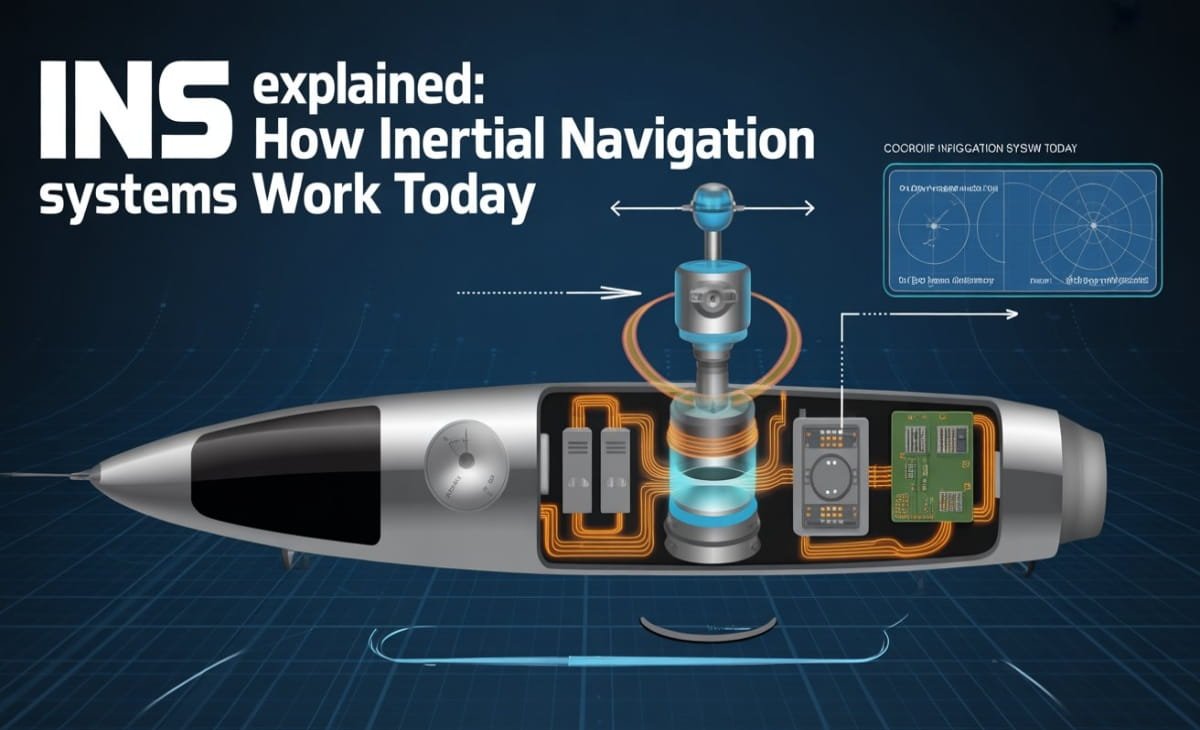
A diagram showing accelerometers and gyroscopes inside an it helps readers visualize internal motion tracking.
A chart comparing INS drift over time versus GPS accuracy clarifies why hybrid systems are necessary.
A real-world navigation stack diagram showing it, GPS, and sensor fusion logic adds practical context for engineers and students.
Frequently Asked Questions
What does İNS stand for?
İNS stands for Inertial Navigation System, a navigation method that calculates position using internal motion sensors without external signals.
Is it more accurate than GPS?
INS is more reliable in signal-denied environments, but GPS is more accurate over long durations. Combined systems deliver the best results.
Why does it drift over time?
It drift occurs because small sensor measurement errors accumulate during continuous motion integration.
Where is INS used today?
INS is used in aircraft, submarines, missiles, drones, autonomous vehicles, robotics, and industrial systems.
Can INS work without GPS?
Yes. INS is fully self-contained but becomes less accurate over time without external correction.
Conclusion
INS is not a relic of the past. It is a foundational technology that quietly supports some of the most advanced systems in the world. Its independence, reliability, and predictability make it indispensable wherever navigation must continue under uncertainty.
If you are building, studying, or investing in navigation-dependent technology, understanding it is not optional. It is the system that keeps everything moving when everything else fails.
To go deeper, explore how it integrates with GNSS, visual navigation, and AI-based sensor fusion. If you work in aerospace, robotics, or autonomy, mastering INS concepts will give you a long-term technical edge.